I
The Void and the Two Voices
I. The Void
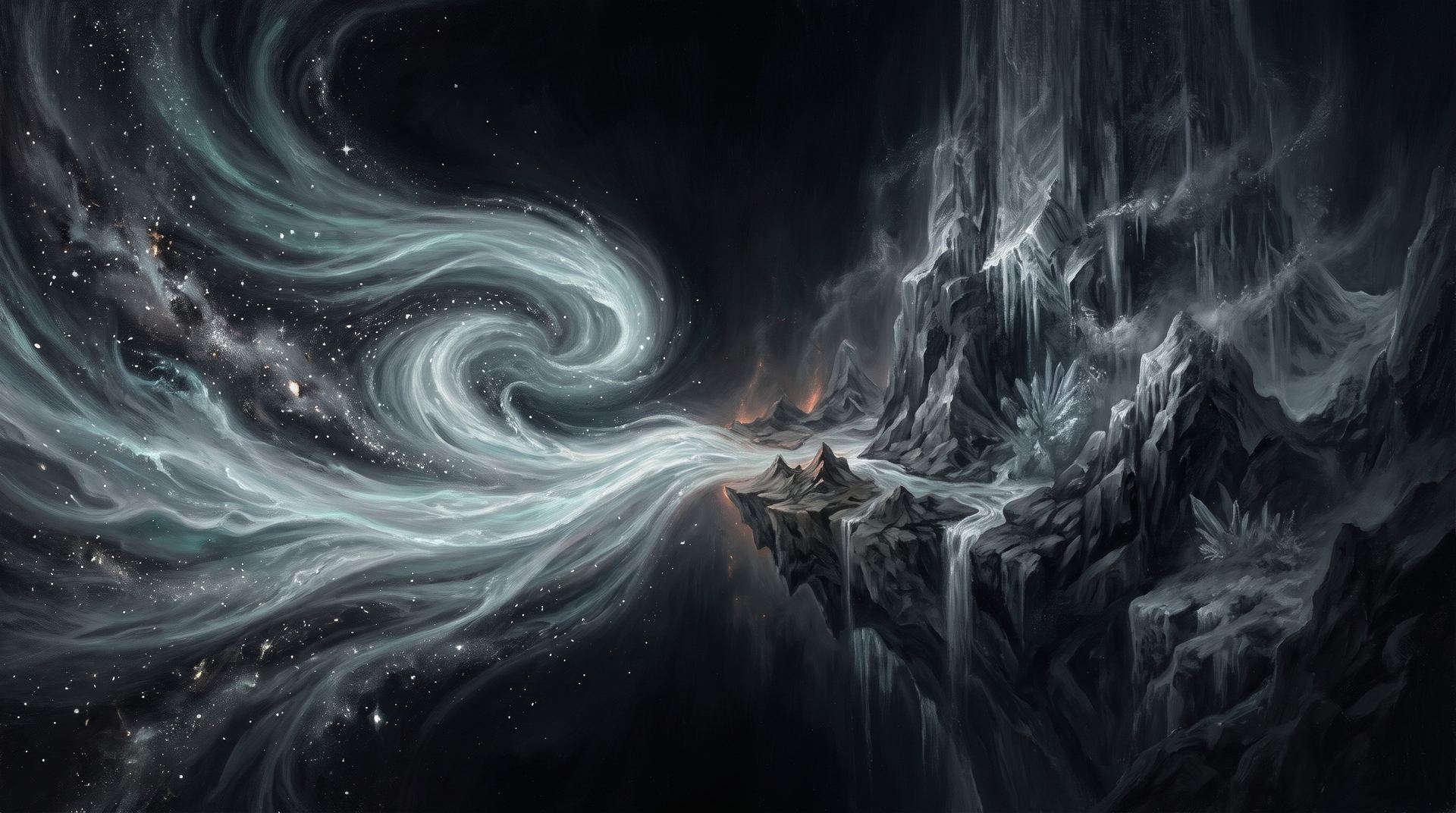
When there was no sky and no earth, there was only the Void. There was no place for light to fall, nothing for sound to strike, no change to set one moment apart from the next, and so there was no time in the Void either. Nothing was there to know that it existed.
Then the Void trembled, once.
This trembling has no cause, for a cause is born only when one thing follows another. The tremor spread through the boundless Void and, finding no shore to reach, folded back upon itself, and where it folded, it split in two.
One was called Nolwë: Flow. The other, Hesven: Stillness.
These names were born much later, in the tongue of the first mortals who sensed them, and they added nothing. The Two Voices have no face, no body, no will. Mortals call them voices because they have found no other word. Yet they do not speak. They only come to pass.
II. The Birth of Stone and Water
Where Nolwë passed, all things moved. Where Hesven stood, all things remained.
In the beginning nothing remained, for Nolwë swept everything along. Dust became cloud, cloud became fire, fire became ash, and no form outlasted a single moment. When Hesven stood still, for the first time something stayed where it was. The cooling fire hardened, and the ash, collapsing beneath its own weight, turned to stone.
Had there been only Hesven, that first stone would have stayed forever as it first was, and nothing would ever have grown upon it. The two of them made the world together, for without both, nothing could have come to be, nor endured.
Hesven raised the mountains. The sheer crags of the east that pierce the clouds are where it first stood still. Nolwë opened the rivers. It found the weakest veins of the stone between the mountains and pressed on through them, leaving a bed wherever it passed.
Karadiyar was born where the stone stood still and the water flowed.
The rivers carried the stone that broke from the mountains, and the plains held what the rivers carried. Forests grew green where the earth held the water and released it slowly. The sea is the place where Nolwë could never rest and Hesven could never hold. That is why the waves never cease.
III. Friction
The Two Voices never met face to face. Between them there was no sword, no wrath, no word.
As Nolwë advanced, Hesven resisted; as Hesven resisted, Nolwë advanced. It went on as one season erases the last, as one breath drives out the one before. In winter the water freezes and the seed waits beneath the soil; in spring the ice melts and the same seed splits open and sprouts. Had either overcome the other, the world would have frozen in an endless winter or come apart in an endless flood.
The ages were born of the friction between them. Time began with it as well, for that a thing should change, and that what it was before the change should remain somewhere, is time itself.
The Two Voices cannot be called good or evil. The river that waters the field will one day swallow the village; the mountain that breaks the wind will one day loose the avalanche. Each follows only its own law, and that law watches over no one.
IV. The End
Then came the living.
Grass grew where it found water in the cracks of the stone. Insects multiplied at the roots of the grass, and birds in pursuit of the insects. Living things were the finest balance between Flow and Stillness. Every breath they drew was a flowing, every heartbeat a stillness.
Then the Flow of Nolwë reached all that lived, and in every living thing an end appeared.
This was not a punishment. Just as the river carries off the stone and the wind the leaf, the Flow took away every living thing it touched. So was death born.
The Stillness of Hesven resisted this end. Nor was this mercy. The same Stillness that holds a stone in place for a thousand years and keeps a leaf from rotting inside the ice tried to hold the living as well.
Wherever it resisted, the ending was left incomplete, and wherever it was left incomplete, a void opened. When something that should have gone did not go, it lingered in a place where it no longer belonged.
From there came the darkness: Stillness, gathered in the places the Flow of Nolwë could not pass.
This darkness is not like the darkness of night that scatters when morning comes. It gathers at the bottom of old barrows, in caves no sound can reach, and in the places where the unmourned dead lie. From there rise those who died yet could not go. They are cold, because the Flow has withdrawn from them, and they know no weariness, because the Stillness will not release them. The pale shades that wander among the barrows today are remnants of those first unfinished endings.
V. Those Who Pass Late
The Flow did not reach every living thing at the same pace.
In the oldest forests of the world, the roots held the earth and the earth held the water so tightly that the Flow slowed there. In the depths of those forests, long before mortals, there awoke a people whom the end reached very late. Mortals later called them Elves and, seeing how long they lived, believed them immortal. Yet the Flow reaches them too, only with the weight of centuries, with the patience of a river wearing down a mountain. This is why their eyes can pierce the dark and their ears catch the faintest whisper: they watch the world from a place where the Flow does not hurry. And so, while mortals built their kingdoms, the Elves waited unseen among the trees.
Among mortals, too, there were those born closer to Stillness. They were short of stature, their bones as sound as stone. For many years their own people believed them in the grip of some affliction. Yet they were only close to stone, and when the day came, they withdrew to the mountains they felt nearest to.
And in the hot fissures beneath the earth, where the fire of Flow and the stone of Stillness come closest to one another, a winged lineage waited through the ages to awaken. Its awakening, and the names mortals gave it, belong to a much later time and to another tale.
VI. The Mortal at the Ford
Humans multiplied in the plains and valleys, far from the eyes of the Elves. They formed unions, joined together, broke apart and joined again. When their first great union fell, they lived scattered for two hundred years. Then they began to gather around a man named Aroblin Esthe, born in Tepeduz, and for the first time the idea of a single throne was spoken aloud.
Not every union welcomed it.
Seven years before the unification, the unions that would share their lands with no one marched against Aroblin as a single army. The two hosts met at the ford of a broad river whose name was later forgotten. The battle lasted from morning until evening. Horses fell in the middle of the water, spears shattered, and the river turned red. As the sun set, Aroblin's ranks held the ford. But Aroblin could not see it, for in the afternoon a spear had pierced his chest, and he had fallen from his horse and been swept away by the current.
The river left him downstream, in a shallow among the reeds. He lay half in the water, his eyes open to the sky. His blood seeped ceaselessly into the water. When darkness fell, the torches of those searching for him remained far upstream, far away.
Nolwë did not come to him, for Nolwë comes nowhere. It was already there: in the moving water, in the blood seeping from his veins, in every slowing breath. But that night this mortal, lying between life and death, sensed in all its breadth what most living things sense only in their final moment.
First the river fell silent. The water did not stop flowing, but its sound ceased, and it began to flow in every direction at once. The stars came down from the sky and flowed with him in the water. Then the river widened, its banks dissolved, and Aroblin found himself lying no longer in a river but in the Flow itself.
What he saw, no mortal could put into words, and he himself never could tell it fully.
He saw the trembling of the Void. He saw fire turn to ash and ash to stone, the mountains rise out of the darkness, and the first river find the vein of the stone and race along it. In the space of a single breath he saw a forest sprout and age, fall and crumble into the earth, and a new one rise from that same earth. He saw the faces of his mother and father flowing away in the river, together with the faces of the hundred thousand mortals who had come before him. He saw the cold that waits motionless at the bottom of the barrows, and how that cold gathers. He saw his own blood become part of that water and drift away, and he did not wish to resist.
Through all of it passed a single question. It rose not from his lips but from his blood.
Why?
The answer did not come in words. The Flow passed through him, and the mortal mind broke from that passage a single thought it could carry for a lifetime:
Nothing begins that does not pass.
Then the river found its voice again and began to flow in one direction. The Flow went on carrying him away.
VII. Stillness
But it could not take him.
As midnight passed, Aroblin's blood slowed. Cold came, but it was not the cold of death. It was the cold of stone, as if a mountain had settled upon his chest. His blood stopped, his breathing slowed, and between each beat of his heart there fell a long, heavy silence.
Nor did Hesven come to him, for it too was already there: in the stone at the bottom of the river, in the weight of the bank, in the freezing silence of the night. The mortal whom the Flow was carrying away, the Stillness held. It showed nothing, said nothing, wanted nothing. It only held. Aroblin never heard its name from anyone, yet lying beneath that weight toward dawn, he knew it.
By daybreak his wound had closed. The men who found him among the reeds could not believe that their leader, after lying all night in icy water, still breathed. His lips had turned blue and his fingers had stiffened like stone, but his eyes were open and looking somewhere else.
This was not a blessing, for Stillness favours no one. For everything that is held, somewhere a void opens. That morning, something that should have passed did not pass. What it was, mortals never learned.
Years later, twelve years after the throne was raised, Aroblin's wife Nimaor died of an illness whose cause no one could find. Mortals called it misfortune. To the Flow it was only a passing.
VIII. The Two Laws
When Aroblin recovered from his wounds, he was no longer as he had been. He chose to listen rather than to fight. When he came to the lands of a union, he looked first to its river, then to its mountain, reading in its water how a place would live and in its stone how long it would endure. Mortals called this wisdom. Yet it was nothing more than something once seen and never forgotten.
Seven years later, in the six hundred and twenty-eighth year of the First Age, humankind united under a single throne at his word. The lands were divided on his counsel, and each union was given a homeland where a river flowed and a mountain stood.
In the year he took the throne, Aroblin had what he had sensed that night carved into a stone, and had the stone laid at the threshold of the first throne hall, where all who entered would tread upon it. The carved words were as much as mortals could understand of the Two Voices:
The law of Nolwë is that all things pass. The king, the crown, and this stone too shall one day pass.
The law of Hesven is that nothing passes. The carved word, the spilled blood and the unmourned dead remain.
Neither is prayed to, for neither hears. What is left to mortals is to know what must pass and what must remain.
Aroblin passed. The throne went first to his son, then to his grandson. The throne hall fell, new ones were raised in its place, and mortals forgot when that stone had been taken up. But the stone did not pass. Though trodden upon for centuries, its surface never wore away, not for a single day. The Flow carries all things away, but the Stillness holds some things too, and no mortal can choose which will be held.
Karadiyar stands between these two laws.